Thursday, 31 May 2012

GDP at 5.3%: India Inc seeks 'immediate corrective actions'


NEW DELHI: With GDP growth slowing to a nine year low of 6.5 per cent in 2011-12, industry on Thursday demanded a revival package to put the country's economy back on higher growth path.

"A comprehensive 'Economic Revival Package' has to be announced at the earliest," CII director general Chandrajit Banerjee said.

Demanding bold actions from the government and the RBI exclusively aimed at salvaging the economy, the chamber expressed hope the political leadership, across party lines, would converge and their actions would be "swift and decisive".

Ficci said the current global situation remains fragile and there is an urgent need to take steps on the domestic front to guard against uncertainties.

Seeking "immediate corrective actions", Assocham president Rajkumar Dhoot said: "Investment environment should be improved and this may even call for some review of tax proposals and further relaxation of FDI norms".

He said fall in the growth numbers would have impact on employment generation.

CII said repo rate and CRR cuts are called for from RBI as also measures from the Government to kick start the investment cycle, since growth in capital formation has been negative for the last few months.

At 6.5 per cent, the GDP growth in 2011-12 has been at a lower level than during the crisis period growth of 6.7 percent.

Industry was of the view that the Centre and state governments have to work in tandem to ensure that major projects that are held up are put under implementation mode within one month.

India is a gasping elephant: HSBC

Global banking giant HSBC today termed India as a "gasping elephant" as the slowdown in economic growth is "deepening" and the downside risks to the outlook have increased.

In a research note, HSBC said the slowdown in growth has proven deeper than expected and blamed administrative obstacles and policy paralysis for the same.

India's economic growth rate slowed to a nine-year low, in March quarter at 5.3 per cent and 6.5 per cent for 2011-12.

The decline in growth was witnessed in almost all segments of the economy, including agriculture, manufacturing, mining and construction.

At 6.5 per cent, the GDP growth in 2011-12 has been at a lower level than during the crisis period growth of 6.7 per cent.

"Administrative obstacles have held back key investment projects and the much talked about policy paralysis has significantly hurt investor sentiments and added to the negative external spill overs trough the finance channel," it said.

Going ahead, the downside risks to the economy have increased as policy paralysis in the country is not likely to ease anytime soon.

"With policy paralysis not likely to ease any time soon, however, India may have to settle for sub-par growth and elevated inflation over the next couple of years," the HSBC report said.

Slowdown in investments has significantly lowered the growth potential of the economy and to boost growth over the medium term, India needs deep supply side reforms but with the given administrative bottlenecks.

"To lift growth more notably, going ahead India needs more traction on deep supply side reforms, which will lift potential growth over the medium term. This will also help lift growth in the short term by improving sentiments and, thereby, the private investment cycle," HSBC said.

The weaker than expected GDP growth numbers are likely to increase pressure on the Reserve Bank to cut policy rates further. However, the lingering inflation pressures suggest that monetary policy cannot be eased aggressively.

" ... traction on deep rooted structural reforms is needed to significantly improve the inflation-growth trade-off in the short as well as medium term," HSBC chief economist for India & Asean Leif Lybecker Eskesen said, adding that the RBI will have to approach any further easing with "caution".

The Reserve Bank of India is scheduled to announce its mid-quarter credit policy on June 18.

Friday, 25 May 2012

IPL 5: Delhi Daredevils' decisions ensure third consecutive final berth for Chennai Super Kings

There appeared to be no logic to any of the decisions taken by the Delhi team management in the crucial second qualifier, right from the selection to the batting order.

Chennai opener Murali Vijay cashed in, plundering a hapless attack as CSK made their third final in a row after winning by the huge margin of 86 runs.

For starters, Morne Morkel, Delhi's Purple Cap holder, was inexplicably dropped to maintain the 'balance' in Irfan Pathan's absence.

Delhi chose to go in the little-known Sunny Gupta instead. If that was not enough, Virender Sehwag chose to field first on winning the toss on this surface. Then, faced with a stiff target, the skipper didn't come out to open. The only ones not complaining were Chennai, who raced away to the highest score of IPL 5 and now face Kolkata Knight Riders in Sunday's final.

Vijay showed why MS Dhoni insists on persisting with him, smashing 113 off 58 balls as the Super Kings notched up 222/5. In reply, Delhi could only manage a feeble 136, being bowled out in 16.5 overs. Only Jayawardene, with a 38-ball 55, offered a bit of resistance.

Sunny Gupta was asked to bowl the first over and Vijay didn't miss this chance to get into the rhythm. He stepped out against his statemate and put him over the top twice in the very first over, setting the pattern for the plunder.

Gupta eventually gave away 47 from three overs. Even Varun Aaron had an extraordinarily bad day, giving away 63 off his four overs, setting another unwanted IPL record.

With no Morkel, there was nothing in the Delhi attack that could have put CSK under threat. Mike Hussey and Vijay raced to a 68-run first wicket stand in eight overs. After Hussey got out, Suresh Raina took over, but it had to be Vijay's night. When Virender Sehwag introduced himself in the 11th over, Vijay stepped out and thrashed the Delhi skipper and there was no looking back for Chennai.

The moment there was a lull, one among Raina and Hussey brought out the big shots. And the onslaught didn't stop even after Raina got out.

Dhoni brought out his helicopter shot yet again as all Delhi bowlers could do was to fetch the ball from the galleries.

Foreign investors more averse to investing in Indian equities now

MUMBAI: Foreign investors have become more averse to investing in Indian equities even as Goldman Sachs and Bank of America Merrill Lynch lowered their growth forecasts for the Indian economy, on Friday.

As per a fund managers' survey conducted by Bank of America Merrill Lynch (BofAML), India's ranking preference has deteriorated over the past one month. Over 55% of the 234 offshore fund managers who participated in the BofAML poll in May are underweight on Indian equities. Only 22% of the respondents were bearish on Indian equities in April.

Giving weightage to the survey, BofAML, in a separate economy report, lowered India's growth forecast by 30 bps to 6.5% for the current fiscal. International bank Goldman Sachs, too, has revised downwards its India GDP growth forecast, from 7.2% to 6.6%, on Friday. Macro-economic concerns, coupled with a weak rupee and concerns about the raging credit crisis in Europe, have prompted foreign fund managers to reduce exposure to Indian equities.

"We are revising our GDP growth forecast largely due to a weaker investment outlook, in part driven by domestic policy uncertainties and more back-ended and lesser monetary policy easing, and in part by prevailing global uncertainties," said the Goldman Sachs report.

According to the BofAML report, RBI's open market operations will help improve liquidity in the system. Unless liquidity improves, banks will not be able to cut lending rates even if RBI cuts policy rates. The Centre will have to effect further fuel price hikes, to enable the central bank to cut rates at a faster pace. With regards to the rupee's weakening, BofAML expects the government to issue an NRI bond to recoup the $20 billion worth forex intervention since November.

In line with the weakness in global markets, Asian markets (excluding Japan) recorded outflows of $240 million the week ended May 18. With the exception of Taiwan and Vietnam, all the regional markets saw investment outflows, the most significant being India, South Korea and the Philippines. Indian markets have reported foreign inflows worth $8.59 billion since January this year.

Elsewhere in Asia, investors have reduced their exposure to China (+22%) to the lowest level in seven months. Thailand (+8%), Indonesia (+6%) and Hong Kong (+6%) were also favourites. Fund managers remain staunchly underweight on Australia (-17%) for the fifth consecutive month, says the BofAML Survey.

No weddings in garbage village


BANGALORE: Young men from Mavallipura, off Yelahanka, are facing the prospect of permanent bachelorhood - not because they are not suitable boys, but because brides are turning up their noses at their village. For Mavallipura stinks. It is Bangalore's landfill, a huge garbage mountain.
Since 2007, at least 10 million tonnes of municipal solid waste has been dumped here, spreading a stench in 12 villages in the surrounding area.
"Parents of girls who visit the village filled with garbage heaps, low yield giving farms and lack of hygiene, refuse to give their daughters in marriage to boys of Mavallipura," says B Srinivas, a gram panchayat member of the village.
"The village does not have clean water supply, so we pay Rs 500 for water from tankers. We are not able to grow crops as we used to earlier. There is also a permanent stench and dog menace. Dogs destroy our crops and our cattle are afraid of them. This village has lost its charm," said Muniraju R, a villager of Mavallipura.
The other affected villages are: Kurubarahalli, Lingarajapura, Subedar Palya, Shivakote, Ramagondanahalli, Mylarahalli, Belekere and Muttyadahalli, which are within a 10km radius of Ramky plant at Mavallipura.
BBMP commissioner MK Shankarlinge Gowda said he had received a proposal to set up a plant in the area, to generate power from the waste. "I have heard the villagers' woes. But there is a dearth of land in disposing of the city's waste," he said.
On Friday, an inspection team comprising the BBMP commissioner, corporators and officials wore masks during their hour-long inspection of the site.

Ramky blames BBMP
Ramky Infrastructure Ltd, the contractors managing the landfill, blamed BBMP for the problem. "The plant is overburdened. The capacity of our plant is to process only 350 metric tonne of garbage. But now, we get 700-800 tonne of garbage and it is impossible to process it. We had asked for 100 acres of land, but have been given only 43 acres," D K Narayan, incharge of the plant, told TOI.
Health hazard
The effects of the garbage are many - health and ecology are the first casualties.
Leachate, one of the end products of the garbage processing unit, contains arsenic and cadmium, toxic components kept open which lead to ecological imbalance in the village. There was a dengue death here in 2010 due to unhygienic conditions and the mosquito menace.
The garbage sent from the city has affected vegetable crops, grape and banana farms in the village. "We grow all kinds of vegetables, grapes and bananas. But in the past three years, the yield has reduced drastically and the crops die because of the filth. Our social life is affected. We can't even have our meals peacefully, because of the unbearable stench that spreads because of the garbage accumulated in Mavallipura plant," said Srinivas B.
Blamegame
BBMP doctors who visited the leachate storage unit and processing unit at the Mavallipura dump yard, blamed the contractor for not taking preventive measures to avoid ecological damage in and around the area. Dr K N Geetha Shashikumar and Dr Shivaprasada MS, corporators and professional doctors, said leachate is dangerous as it contains cadmium and arsenic.
Health camps stopped
Last year, then BBMP commissioner Siddaiah had initiated a health camp in the area for the villagers, but these are now discontinued, said Muniraju S, a villager.
According to the Solid Waste Management Rules 2000, there should be no habitation within a 10km radius of such landfills and dumps. But the plant is situated right in the middle of the village.

Cautious babus, coalition stalling decisions: Kaushik Basu

A month after he was forced to backtrack on his comment about gridlock slowing down economic reforms, the government's chief economist, Kaushik Basu, acknowledged on Friday that coalition compulsions and an excessively cautious bureaucracy have snagged decision making. In an e-mailed interview, Kaushik Basu discusses the rupee fall and the slowdown in decision-making.
 RBI's response to the recent rupee depreciation has been, in my view, balanced and aptly measured. The bulk of the recent exchange rate depreciation is not an India-specific problem but has global roots. You have to take my views on these seriously because I have in the past criticized RBI. And, I have also refused to put all the blame for all our troubles on the global economy; in fact, some of my own troubles stem from this refusal.

It is easy to over-react to exchange rate movements, because whether it is an appreciation or depreciation, some people get hurt, and going by the human nature, that group will be the most vocal. RBI's aim should be to curb volatility and not to try to buck the market trend. While excessive depreciation is indeed worrisome, it has to be recognized that this is a global phenomenon.

Several emerging economy currencies have been depreciating since August 2011 and sharply over the last two months. The South African rand, the Brazilian real, for instance, have moved in step with rupee and, over the last six weeks, the Korean won and the Mexican peso have also sharply depreciated.

This is a response to the Eurozone uncertainty and flight of capital to the safety of US treasuries and a few other havens; and we will have to live with this until at least June 17 - the time of the Greek election. I believe the depreciation is an over-reaction - a global bubble that will partly correct itself eventually.

Has the government done its bit to tackle the rupee? What has the government done to attract inflows? Are more steps needed?

Appreciation and depreciation offer different magnitudes of difficulty because the former needs access to rupee or, as some would say, a printing press, and the latter to forex reserves, which are limited. There are basically two ways to tackle a depreciation: RBI releases forex reserves in the market and opens the doors to more capital inflows. Both these are being done.

But, we have to realize that given the fact that India has had higher inflation than the US, the nominal exchange rate depreciating over the last two years is only to be expected. The impression given at times that we expect the rate to be at the same level as in January 2011 is unrealistic and markets can call the bluff. When we intervene it should be limited, conditional intervention without trying to hold the rupee value artificially high.

Having said this, I must point out that what is getting overlooked is that depreciation is also an opportunity -the opportunity to export more. Till recently, everybody used to envy China flooding the world with its goods using the leverage of its depreciated currency. Canada gained massively in the global market when the Canadian dollar used to be weaker by over 25% vis-a-vis the US dollar. And Iceland is climbing back to normalcy on the shoulders of a weaker krona. So, while taking steps against excessive depreciation, what we must do and are not doing enough is to get our exports booming. We need to remove hurdles, bureaucratic and otherwise, to achieve this.

There is a perception that the government has been lethargic in its policy responses. Some commentators say that "the gloom and doom in the economy" is linked to the policy paralysis in government? Your views on the whole issue of policy paralysis...

I agree with this criticism; there has been a slowdown in decision-making because of over-caution on the part of bureaucrats and slowdown in reforms because of the strains of coalition. I expect - or should I say hope -- this will change sooner rather than later.

Monday, 21 May 2012

Rupee breaches 55 barrier against dollar

MUMBAI: Continuing its downward drift, the rupee crossed a new all-time closing low of 55 against the dollar, settling at 55.04. The trend persisted in the absence of any major flows despite intervention by the Reserve Bank of India.

Dealers said that given the current inclination, the currency could slide to 56 to 57 levels. However, any depreciation beyond this level could trigger panic and lead to a currency crisis, which would force the central bank to come out with concerted efforts to support the rupee.

"Although there was resistance at the 53.90 levels, the rupee could not hold up for long," said a dealer. "The slide was almost entirely because of dollar demand from importers and the weakening of the euro in the international market.

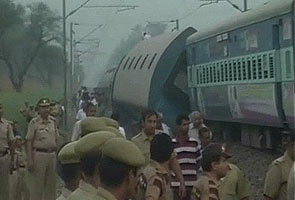
Train accident in Andhra Pradesh: 2 killed, several injured as Hampi Express collides with goods train

HYDERABAD: At least 2 people have been killed and several others injured in an early morning train accident in Andhra Pradesh.

The accident happened when Hampi Express collided with a stationary goods train in Penukonda at around 3am, according to TV reports.

According to initial reports coming in, Hampi Express overshot signal and hit the goods train. It was travelling from Hubli to Bangalore.

Two bogies of Hampi Express have derailed. Several people are still trapped inside the mangled bogies of the train.

Rescue operations are underway to take out the trapped passengers. Gas cutters are being used to cut the mangled coaches.

According to TV reports, the local administration and the railway authorities have confirmed two deaths as of now.

The toll is likely to rise.

Thursday, 17 May 2012

Facebook's IPO one of the world's largest, prices at $38 per share

NEW YORK: Facebook's initial public offering of stock is shaping up to be one of the largest ever. The world's definitive online social network is raising at least $16 billion for the company and its early investors in a transaction that values Facebook at $104 billion.

It's a big windfall for a company that began eight years ago with no way to make money.

Facebook priced its IPO at $38 per share on Thursday, at the high end of expectations. The IPO values Facebook higher than Amazon.com and other well-known companies such as Kraft, Disney and McDonald's.

Facebook's stock is expected to begin trading on the Nasdaq Stock Market sometime Friday morning under the ticker symbol "FB." That's when so-called retail investors can try to buy the stock.

Facebook's offering is the culmination of a year's worth of Internet IPOs that began last May with trailblazer LinkedIn Corp. Since then, a string startups focused on the social side of the Web have gone public, with varying degrees of success. It all led up to Facebook, the company that's come to define social networking.

"They could have gone public in 2009 at a much lower price," said Nick Einhorn, research analyst at IPO investment advisory firm Renaissance Capital. "They waited as long as they could to go public, so it makes sense that it's a very large offering."

Facebook Inc. is the third-highest valued company to ever go public, according to data from Dealogic, a financial data provider. Only the two Chinese banks have been worth more. At $16 billion, the size of the IPO is the third-largest for a US company. The largest U.S. IPO is Visa, which raised $17.86 billion in 2008. No. 2 is power company Enel and No. 4 is General Motors, according to Renaissance Capital.

The $38 is the price at which the investment banks orchestrating the offering will sell the stock to their clients. If extra shares reserved to cover additional demand are sold as part of the transaction, Facebook Inc. and its early investors stand to reap as much as $18.4 billion from the offering.

For the Harvard-born company that reimagined online communication, the stock sale means more money to build on the features and services it offers its 900 million global users. It means an infusion of funds to hire the best engineers to work at its sprawling Menlo Park, California, headquarters, or in New York City, where it opened an engineering office last year.

And it means early investors, who took a chance seeding the young social network with start-up funds six, seven and eight years ago, can reap big rewards. Peter Thiel, the venture capitalist who sits on Facebook's board of directors, invested $500,000 in the company back in 2004. He's selling nearly 17 million of his shares in the IPO, which means he'll get some $640 million.

The offering values Facebook, whose 2011 revenue was $3.7 billion, at as much as $104 billion. The sky-high valuation has its skeptics, who worry about signs of a slowdown and Facebook's ability to grow in the mobile space when it was created with desktop computers in mind. Rival Google Inc., whose revenue stood at $38 billion last year, has a market capitalization of $207 billion.

"There seems to be somewhat of a hype around the stock offering," says Gartner analyst Brian Blau. That, of course, is an understatement.

Facebook's IPO dominated media coverage in the weeks and days leading up to the event. Zuckerberg's hoodie made headlines as did General Motors' decision to stop advertising on the site and rival Ford's affirmation that its Facebook ads have been effective.

There are a few reasons for the exuberance. First, there's Facebook's sheer size and high profile. The company grew from a college-only social network created in Zuckerberg's dorm room at Harvard in 2004 to an Internet phenomenon embraced by legions of people, from teenagers to grandmothers to pro-democracy activists in the Middle East.

Secondly, it's personal.

"It's probably one of the first times there has been an IPO where everyone sort of has a stake in the outcome," Blau says. While most Facebook users won't see a penny from the offering, they are all intimately familiar with the company, so it resonates as something they understand.

And then there's CEO Mark Zuckerberg, who turned 28 on Monday. He has emerged as the latest in a lineage of Silicon Valley prodigies who are alternately hailed for pushing the world in new directions and reviled for overstepping their bounds. He counted the late Apple CEO Steve Jobs among his mentors and he became one of the world's youngest billionaires, at least on paper, well before Facebook went public. A dramatized version of Facebook's founding was the subject of a Hollywood movie that won three Academy Awards last year, propelling Zuckerberg even further into the public spotlight.

Though Zuckerberg is selling about 30 million shares, he will remain Facebook's largest shareholder. He set up two classes of Facebook stock, building on the model Google co-founders Larry Page and Sergey Brin created as part of the online search leader's 2004 IPO. The dual class structure helps to ensure that he and other executives keep control as the sometimes conflicting demands of Wall Street exert new pressures on the company.

As a result, with the help of early investors who've promised to vote their stock his way, Zuckerberg will have the final say on how nearly 56 percent of Facebook's stock votes.

True to form, Zuckerberg and Facebook's engineers are ringing in the IPO on their own terms. The company is holding an overnight "hackathon" Thursday, where engineers stay up writing programming code to come up with new features for the site. On Friday morning, Zuckerberg will ring the Nasdaq opening bell from Facebook's headquarters.

Ageing Brand SRK loses youth connect

MUMBAI: He was, arguably, the biggest Bollywood superstar not long ago but with a few unsuccessful releases, a night club brawl and now a scuffle with officials at a Mumbai cricket stadium to his credit, Shah Rukh Khan's brand is losing sheen.

In the last couple of years, the actor has not signed any big brand endorsement deals although his portfolio still boasts of more than a dozen brands. People in the endorsement industry say that SRK's image has suffered in the last couple of years not only due to the controversies that have surrounded him but also because he is an ageing celebrity.

"Controversy does not make for good brand endorsers and any marketer will keep away from a celebrity like that. Besides the controversies that have courted him recently, what is a bigger concern is that he is ageing and that does not bode well for multiple brands in India that want a youth connect," says Manish Porwal, MD, Alchemist, a talent management agency.

Wednesday, 16 May 2012

Pak envoy meets home secretary ahead of talks


NEW DELHI: Pakistani high commissioner Shahid Malik on Tuesday met home secretary R K Singh and is learnt to have discussed various aspects of the forthcoming home secretary-level talks between the two countries which is scheduled to be held in Islamabad on May 24-25.

The two countries are expected to sign a liberalized visa agreement during the talks. The new visa agreement, if signed, will allow 'certified' businessmen from both sides to get one year multiple-entry 'non-police reporting' visa. It will also allow them to visit five cities instead of three at present.

The new visa regime will also benefit elderly people from both sides as they will be exempt from police reporting. The Cabinet had given its nod to the pact on April 25.

The Indian delegation will also press for action from Pakistan to bring the Mumbai attack perpetrators, including JuD chief Hafiz Saeed, to justice and speedy trial in a Pakistani court of seven 26/11 accused like Zakiur Rehman Lakhvi, sources said.

Aamir Khan can take heart from conviction against sex selection


NEW DELHI: Actor Aamir Khan, whose first episode of tele-show Satyamev Jayate focused on sex selection, will be happy to hear this.

In 2011, 21 clinics and 22 doctors were convicted under the Pre-Conception and Prenatal Diagnostic Techniques (Prohibition of Sex Selection) Act, 1994, for carrying out sex selection of an unborn child.

Census, 2011, showed girl child is still a curse and unwanted. And, the girl child population has fallen to an all-time low since Independence. The sex ratio for 2011 stands at 914 girls down from 927 girls for 1,000 boys in 2001.

Maharashtra led the way in 2011, with the highest number of convicted cases against doctors at 15, followed by Haryana (7) and Madhya Pradesh (2).

Majority of the punishments included three years of rigorous imprisonment and a fine anywhere between Rs 1,000 and Rs 1.3 lakh.

Dr Ambadas Kadam from Maharashtra was convicted on November 14, 2011, with a three-year jail term and had to cough up the highest compensation of Rs 1.3 lakh.

All the convictions in Haryana resulted in a three-year jail term, and also had to pay fines between Rs 1,000 and Rs 10,000.

The two convictions in MP resulted in imprisonment of one month and a fine of Rs 1,000. Maharashtra, however, made an example of such cases. The minimum jail term in all the convictions in the state was two years. Fines charged were Rs 70,000, Rs 60,000, Rs 52,000 and Rs 38,000 in majority of the cases.

According to Union health ministry's figures, only around 6% of cases filed against doctors involved in sex selection practices in the 17 states with the most skewed sex ratio had ended up in convictions till March, 2011.

Altogether 805 cases had been filed in court against doctors till March 31, 2011, ever since the revised PC and PNDT Act came into force. Only 55 convictions were recorded during the same period.

The rest of the cases were either still going on or dropped for "poor investigation and insufficient evidence against the accused".

Till March, 2011, convictions were highest in Haryana (23), followed by Punjab (22), Gujarat (4), Maharashtra (3), Delhi (2) and Chandigarh (1). The highest number of cases against doctors was filed in Rajasthan (161), but none has resulted in conviction till date.

Maharashtra filed 139 cases, Punjab (112), Gujarat (82), MP (70), Delhi (61), Uttar Pradesh and Haryana (54), Andhra Pradesh (19), Bihar (10), Uttarakhand (9), Chhattisgarh (5), Jharkhand (3) and Chandigarh (2).

During the same period, 168 ultrasound machines were sealed in Gujarat, followed by Haryana (133). Maharashtra sealed 82 machines, Rajasthan (76), Odisha (68), Delhi (48), Punjab (26), UP (37), Jharkhand (13) and Andhra Pradesh (12).

"Recent meetings impressed upon states on the importance of follow up of a court case, building a strong case for prosecution, putting in place the mechanism for legal assistance and engagement with state legal services authorities, besides training workshops for judiciary and public prosecutors," an official said.

An official added, "India's conviction rates are shockingly low. That's because doctors, who carry out the search and seizure operations, aren't good at filing legal cases and presenting a full-proof investigation, helping violators go scot-free."

The 17 states were recently told by the ministry to identify and map their worst-affected districts, blocks and even localities.


Aarushi-Hemraj murder case hearing in 3 courts today


NEW DELHI: The Allahabad high court will on Wednesday hear Nupur Talwar's bail plea in the case. Nupur has been in the Dasna jail for the past 17 days.

The case will also come up in the Supreme Court that will continue hearing arguments on the Talwars' review plea, which seeks the quashing of the trial court's order.

On Tuesday, the CBI handed over CDs and documents to the defence counsel as directed by the session court during Monday's hearing.

However, the agency was unable to provide all the documents as they ran into thousand of pages, said CBI counsel.

14-year-old Aarushi was found murdered on the intervening night of May 16-17, 2008 at her Noida residence and the body of Hemraj was found on the terrace of the house the next day.


Tuesday, 15 May 2012

2G spectrum case: A Raja gets bail, to walk out of Tihar jail after 15 months

NEW DELHI: A special CBI court on Tuesday granted bail to former telecom minister A Raja, who is a prime accused in the 2G spectrum allocation scam and has been in custody for the past 15 months.

Raja's counsel had argued for bail on grounds of parity. The court granted bail to Raja on his furnishing personal and surety bonds of Rs 20 lakh each. Raja was also directed not to visit Tamil Nadu without the court's prior permission.

On May 11 special CBI judge O P Saini had reserved his order on Raja's bail plea for today after hearing arguments from the CBI and counsel for the DMK MP.

Raja has sought bail on the ground of parity with other 13 co-accused who have already secured it from the Supreme Court, Delhi high court and the trial court. In his bail plea, Raja said that the case against him was "false and fabricated" and "not sustainable in law".

The CBI had vehemently opposed Raja's bail saying he could not be released on the ground of parity as the charges levelled against him were of serious nature. During the probe, it had come to light that Raja and others received bribe of Rs 200 crore in connection with the scam, it said.

Raja had filed the application soon after former telecom secretary Siddharth Behura, who was arrested along with him on February 2 last year, was granted bail by the Supreme Court.

Besides Raja, DMK MP Kanimozhi, Behura, Raja's former private secretary R K Chandolia , Swan Telecom promoters Shahid Usman Balwa and Vinod Goenka, Unitech Limited MD Sanjay Chandra and Reliance Anil Dhirubhai Ambgroup executives Gautam Doshi, Surendra Pipara and Hari Nair are facing trial in the case.

IPL spot-fixing: BCCI may suspend guilty players

NEW DELHI: Cracking the whip, the Board of Control for Cricket in India (BCCI) may suspend the two players who were caught in a TV sting operation admitting to spot-fixing in IPL.

According to Times Now, the BCCI is likely to suspend T Sudhindra and Shalabh Shrivastava from all forms of cricket.

Sources added that the decision will be taken in the IPL General Council meeting that is scheduled to be held later on Tuesday.

On Monday, a sting operation carried out by India TV showed five domestic-level players, representing various IPL franchises, apparently succumbing to the lure of fixing.

It showed these players discussing the alleged involvement of IPL captains and even team owners in such activities and engaging in lengthy haggling over the price of bowling a no-ball on demand in the IPL.

The players were also seen discussing deals in which IPL owners allegedly pay players sums "in black" well beyond the slabs prescribed by the league.

The accuracy of the channel's claims or the statements attributed to the players could not be independently verified by TOI.

The five players caught on camera include Team Hyderabad pacer T Sudhindra, formerly of the rebel ICL, who is shown confessing to having bowled a no-ball in a domestic game at the TV channel's insistence and boasting that spot-fixing, could be done at any level of Indian cricket, including IPL.

Spot-fixing is common but the rates differ according to the standard of the game, the player apparently insisted. Sudhindra was also shown as saying that franchisees were gifting players cars and flats since the IPL had capped remunerations for first-class players.

Team Punjab's left-arm pacer Shalabh Shrivastava is another former ICL player apparently caught on camera. He apparently said that franchisees, hampered by the Rs 30 lakh cap on domestic players, were paying some players an additional Rs 70 lakh in black money.

He is also seen demanding Rs 10 lakh per no-ball for the IPL and claiming women were being used to befriend players before cajoling them into fixing games. Shrivastava added that "two or three" out of 10 players were vulnerable and that "everyone got offers".

Saturday, 12 May 2012

Behind Army Leh clash, breach of rules, failure of command

The violence at a Ladakh firing range, constituting one of the most serious discipline-related incidents in the Army in recent years, was the result of a series of rule breaches by officers. Sources indicated a trust deficit between officers and jawans, including failure of the command structure, and a rumour about a badly beaten jawan dying that could not be contained.
The Army has called Thursday’s events a “minor scuffle” resulting in “superficial injuries” to four, who are in hospital. However, sources said the violence lasted several hours and that apart from the commanding officer of 226 Field Regiment, three majors and 10 jawans received injuries. A court of inquiry has been instituted.
In a statement issued today, the Army said the regiment was being moved back to its location, Darbuk, from the firing range. Commanding Officer Col. P Kadam is likely to be moved out for medical care. Kadam was reportedly already scheduled to relinquish command, and the Army said no one has been “removed, dismissed or suspended”.
Slamming “misinterpretation” and “mischievous reporting”, the Army also said, “The entire episode can at worst be seen as an isolated act of indiscipline. It can in no way be termed a mutiny.”
A reconstruction of what transpired at the Army’s Mahi firing range in Nyoma, around 150 km from Leh, on Thursday:
* The 226 Field Regiment had moved from Darbuk to the range for firing practice, and officers and men were staying in temporary tents. However, in a breach of rules, at least five officers allegedly also had their wives accompanying them. While families are usually invited for firing demos of artillery guns, wives and children are strictly not allowed at a firing practice session. Even at Darbuk, only a limited number of families are allowed, given that it is a designated “field area”. The Army says the wives were staying at a nearby GREF (General Reserve Engineer Force) camp.

Apple to drop Google Maps in iOS 6: Report


SAN FRANCISCO: Apple will drop Google Maps from its upcoming mobile platform iOS 6 in favour of its own mapping system, it was reported Friday.

The application design is said to be fairly similar to the current Google Maps programme on the iPhone, iPad and iPod touch, but it is described as a much cleaner, faster and more reliable experience, said technology news website 9to5mac, citing its sources.

Over the last few years, Apple has been acquiring mapping companies like Placebase, C3 Technologies and Poly9. The acquisitions enable Apple to create a complete mapping database of its own instead of relying on Google's solutions, reported Xinhua.

The most important aspect of the new Apple Maps application, according to the report, is a powerful 3D mode, which is technology straight from C3 Technologies, a Swedish company Apple bought last year.

Apple has been gradually pushing Google Maps away. Last week, Apple acknowledged that its iOS iPhoto app, a photo-sorting tool for the iPad and iPhone, had switched from Google Maps data to OpenStreetMap data since March. The app uses mapping data to display the shoot location of geotagged photos.

Apple is scheduled to hold its annual Worldwide Developers Conference in San Francisco from June 11 to 15. The key announcement at this year's conference is expected to be iOS 6, the sixth generation of its mobile operating system.


Friday, 11 May 2012

Nokia's woes might call for Microsoft aid

LONDON: Addressing Nokia Oyj employees in January 2011, chief executive Stephen Elop - at that point only four months into the job - dramatised the company's predicament by comparing it to standing on a burning platform.

Nearly a year and a half on, and with Nokia's Lumia mobile phone range failing so far to revive sales, its position still looks frail. Its shares have lost 90 percent in five years and its debt is rated junk by two of the three major ratings agencies.

Might Microsoft Corp, Elop's former employer and whose software Lumia is based on, have to step in to help Nokia out, seeing the Finnish company as a valuable point of entry into the cellphone market?

No policy paralysis, decision-making is slow in India: Lakshmi Mittal

LONDON: "I do not think there's a policy paralysis, but decision-making is too slow in India," said Lakshmi Mittal, India-born chairman of ArcelorMittal, the world's largest steel company. Speaking exclusively to TOI on Friday, Mittal said, "India needs to move the way the rest of the world is moving to be competitive."

The comments came after Mittal's declaration this week at his firm's annual general meeting in Luxembourg that he foresaw delays in ArcelorMittal's planned Rs 30,000 crore investment in India. When a journalist suggested half in jest if he should speak to West Bengal chief minister Mamata Banerjee, the steel magnate's smile vanished.

"I am very annoyed that she only arrested Marwaris and no Bengalis after the hospital fire. Please carry that," he angrily shot back, referring to Trinamool government action after AMRI hospital fire in Kolkata that killed nearly 100 people.

Mittal, his wife, son, daughter-in-law and son-in-law were gathered on the uppermost platform within the ArcelorMittal Orbit, a sculpture which opened on Friday in the Olympic Park (soon to be named after the British queen, Elizabeth) of this year's London Olympiad.

The conjoining of 2,000 tons of red painted steel pipes - scrap from ArcelorMittal's plants from all continents - curving and zig-zagging up to a height of 115 metres is, arguably, a wonderfully conceived and constructed piece of artistry and architecture.

However, within the structure are two elements: A shiny steel spiralling path-cum-stairway and a rust-coloured canopy. The contrast and hideousness of such frameworks within the exotic exterior have evoked sharp criticism of Indian-born artist Anish Kapoor and Sri Lankan-born architect Cecil Balmond's design, selected from 40 to 50 entries.

"Controversy is okay, it's part of the deal," Kapoor said nonchalantly at a press meet preceding the unveiling of the Orbit.

"I am very pleased, very honoured that Boris gave me an opportunity to participate in the London Olympics," Mittal remarked. Johnson felt the Orbit symbolised cooperation between London and India. "It's important it should symbolise that; that it should symbolise the incredible links, the closeness between London and India," he said.

Thursday, 10 May 2012

Lodge fraud case against Nirmal Baba, says chief judicial magistrate


LUCKNOW: A local court on Wednesday directed Luknow police to register a case of fraud and cheating against Delhi-based self proclaimed godman Nirmal Baba alias Nirmaljeet Singh Nerula.
Chief Judicial Magistrate Rajesh Upadhyaya further directed Gomitnagar police to probe the matter and submit the report in the court. The Judge cited a 1999 Supreme Court ruling and said that if a person present himself as godman capable of treating the disease by his super natural power and takes money for it, the action will fall under the category of fraud.
The order came on the application of two schoolchildren Tanya Thakur (16) and her brother Aditya (13), children of IPS officer Amitabh and social activist Nutan Thakur. It was stated in the application that on April 10, 2012, they moved an application to Gomtinagar for register FIR against Nirmal Baba but the police turned them away. The children also approached the deputy inspector general of police, Lucknow, additional director general of police, UP, but to no avail.
The children stated in their application that Nirmal Baba holds 'durbar' in big cities and metros. His programmes are also aired on different TV channels. The children said that they saw one of his programme on a TV channel and came to the conclusion that Nirmal Baba is cheating ordinary and poor people facing various problems in life through his improbable solutions.
In its order, the court observed that the acts of Nirmal Baba are against scientific temper and rationality. "Not only this, his acts amount to misuse of religion and spirituality. Inviting to deposit money directly in the account in order to solve problems of people is in fact amount to fraud with the society and it should be investigated. Baba's act has also influenced people of Lucknow, hence it is necessary the matter should be probed," the court added. tnn

Pakistan’s postponement of Sir Creek talks to gain leverage on Siachen?


NEW DELHI: Pakistan's latest move of rescheduling talks on Sir Creek is intended to put pressure on Siachen, said sources. This week, Pakistan, after announcing Sir Creek talks with India on May 14 - unilaterally announced that it would not hold the discussions on that date - and later pushed the dialogue to June 22.

Although the official reason from Pakistan is the non-availability of a key negotiator, Indian officials are not buying this argument. With Siachen talks scheduled to be held on June 11-12, the postponement is being seen as trying to pressure India to concede ground on Siachen.

Officials said that India's position on Siachen had neither hardened nor softened for years. But Pakistani Army chief Gen Ashfaq Kayani has now said twice in a month that Islamabad wants the Siachen issue to be solved and India had "toughened" its stand asking for a demarcation. Defence minister A K Antony rubbished Kayani's statement about a tougher Indian stand, instead saying there should be no expectation of anything "dramatic" from the forthcoming talks.

Sources here said Pakistan may be thinking they can leverage the Sir Creek resolution for an Indian concession on Siachen. A resolution on Sir Creek is believed to be "doable", and can be used by Prime Minister Manmohan Singh to justify a visit to Pakistan later this year.

Gen Kayani, while visiting Skardu region last week, after the recent avalanche that killed over 130 military personnel, hoped the Siachen issue would be "resolved so that both countries don't have to pay the cost". He said the hope was that "there will be a resolution and we want that there should be a resolution (of the Siachen issue). There should be a resolution of Siachen and other issues." This was interpreted as a major breakthrough by Gen kayani.

The core of the difference between the two sides is: India wants Pakistan to authenticate positions on the AGPL (Actual Ground Position Line) before any talk of demilitarization or withdrawal. Pakistan is pushing a four-point plan that includes demilitarization, withdrawal of troops, delineation and authentication. India is unwilling to do this.

"We have been consistent on the steps necessary before demilitarization of Siachen can be carried out. We won't give up the advantage we enjoy without a very credible, and verifiable, commitment from their side," a senior Army officer said here. Another officer pointed out that India has repeatedly pointed out that any demilitarization should be preceded by delineation of Actual Ground Position Line (AGPL), authentication of the line and military positions on maps to be exchanged between the two countries, an end to wrong projection of AGPL in each other's maps, drawing up framework for demilitarization and as final step withdrawal of troops down from the glacier. "They are reluctant to agree to our suggestions," another senior military official said.

Pakistan analyst B Raman said, Kayani's remarks came in the wake of the avalanche and the consequent local anger against the army. "His remarks have the tactical objective of responding to local anger and projecting India as responsible for lack of forward movement on the Siachen issue." Former envoy, G Parthasarathy said the interpretation of Kayani's comments were misplaced, because neither side have changed their positions.

Both countries remain in their stated positions. After Kargil, the Indian Army remains even more wary of Pakistani intentions. Senior defence officials said, "If they can violate the Line of Control, then I don't see any reason for them not to violate AGPL," an Army officer argued.

Wednesday, 9 May 2012

‘Awfully busy’ Narendra Modi tried his best to save 2002 Gujarat riot victims: SIT


AHMEDABAD: The Supreme Court-appointed special investigation team (SIT) has done much more than just giving a clean chit to Gujarat chief minister Narendra Modi on allegations of his involvement in the 2002 riots.

Not only does the report, submitted by SIT chairman RK Raghavan, exonerate Modi from the criminal charge of conspiracy and facilitating riots, it goes an extra mile to explain the efforts of an "awfully busy" Modi to protect the riot-affected and offer them relief and rehabilitation.

Experts say the closure report is very different in spirit than the first report submitted by SIT member AK Malhotra, who had questioned Modi's actions on several counts including allegedly deputing cabinet ministers in police control rooms and his negligence towards the riot-affected. Raghavan's report claims Modi visited Gulbarg Society and Naroda Patia, which witnessed two of the worst massacres during the riots, and relief camps on March 5 and 6, 2002.

Stating that the Army was called in well in time, the report further says, "The CM was awfully busy with the steps to control the law and order situation, providing medical treatment to the riot victims, their rehabilitation, giving ex-gratia payment to the riot affected, NGO relief camps and with the payment of compensation for destruction of properties during the riots, and also with his efforts to restore peace and normalcy in the state."

The closure report admits that the state government was wrong in not banning the BJP-supported VHP bandh on February 28, 2002, but in the same breath adds it doesn't amount to conspiracy. On charges of Modi issuing illegal instructions to allow Hindus to vent their anger, the SIT states, "The chief minister emphasized that miscreants (in the train carnage case) should be apprehended and not allowed to escape. He was also concerned about the number of causalities in the incident. The CM gave directions that steps should be taken not to delay medical help for passengers and to impose curfew to avoid any untoward incident, Godhra being a sensitive place."

Tuesday, 8 May 2012

CBI to freeze bank accounts linked to Jagan


New Delhi: The CBI has approached banks for freezing accounts of Jagati Publications and Indira TV owned by Kadapa MP YS Jaganmohan Reddy.

The move by the agency comes a day after a special CBI court in Hyderabad had issued summons to the YSR Congress president directing him to appear before it on May 28 in a disproportionate assets case.

The CBI had also named the representatives of Jagati publications and other business firms associated to Reddy in its chargesheet filed in the court on Tuesday.

The court had also summoned 12 others facing charges in the case to appear before it on the same day.

Managing Directors Srinivasa Reddy (Hetero Drugs), Nityananda Reddy (Aurobindo Pharma), Sarat Chandra Reddy (Trident Life Sciences), senior IAS officer BP Acharya, AP Industrial Infrastructure Corporation's former officer Y Vijayalakshmi, former Company Secretary of Aurobindo Pharma Chandramouli are among those issued summons by the CBI court.

IAS officer Venkatarami Reddy, Ramky Group chairman Ayodhyarami Reddy, Jagati Publications (publisher of Sakshi Telugu daily) and Ramky Pharma India Limited have been named as the other accused in the case.

 CBI said Ramky had invested Rs 10 crore in Jagati Publications as a quid pro quo for the benefits it secured from the then government headed by Jagan's father YS Rajasekhara Reddy.

Besides, representatives of Jagati Publications, Hetero, Aurobindo, Trident Life Sciences, who have been named in the CBI charge sheet, have also been asked to appear in the court on May 28.

Mayawati spent Rs 86 crore of public money on her bungalow


LUCKNOW: BSP chief Mayawati spent over Rs 86 crore of public money to renovate her 13 Mall Avenue bungalow that she is entitled to as a former chief minister. The renovation work began after Maya took over as chief minister in 2007 but the bulk of the work got completed towards the end of her tenure.
This was revealed in an RTI application that SP leader Shivpal Yadav filed when he was the leader of Opposition during Maya's tenure. Though the RTI plea dates back a year, the estate department revealed the details recently.
"We are still assessing the total cost incurred and indications are that the money spent might even exceed Rs 100 crore," a senior estate department official said on the condition of anonymity.
The house sprawls over 5 acres of prime land in Lucknow's Mall Avenue and is guarded by 20-feet-tall walls made of sandstone from Rajasthan. Originally, 13 Mall Avenue comprised only 2.5 acres, but Maya added an adjoining plot which housed the cane commissioner's office and had this building demolished.
The main building is single-storeyed and has six inter-connected rooms. They open on to a wide corridor, which contains rows of lockers. On a wall in this corridor hangs a neatly framed large picture of Mayawati taking her first oath as UP chief minister in 1995. Outside the corridor is a verandah with only two windows, both fitted with bullet-proof glass. Each window cost Rs 15 lakh and was specially designed for the house in Chandigarh.
There's a separate two-storeyed well-furnished guesthouse with 14 bedrooms on the same campus. All rooms have pink Italian marble flooring in keeping with Maya's fondness for pink stone. This building also has a meeting hall, a security room, garages and drivers' rooms.
The lush green lawn of the house that used to be its beauty was converted into a floor made of pink granite. There are two 20-feet statues on the premises, one of Mayawati and the other of her mentor later Kanshiram. Besides, there are five marble statues of elephants.
The buildings were not finished at one go, but involved tearing down of interiors several times because Maya was often not fully satisfied. One bathroom in the main building was redone about a dozen times because Behenji did not find it to her taste, an official said.
To secure the house, the home department put up a barbed fencing round the boundary walls. A close-circuit TV network kept close watch on visitors.
The renovation of this bungalow was clubbed with the building of parks and memorials erected in memory of Dalit icons. The job was assigned to the Nirman Nigam, which accorded top priority to the bungalow's renovation.
Shivpal Yadav, who's now PWD minister, said an inquiry has been ordered and action will be taken against those found guilty of any lapses and irregularities.
Estate department officials wished not to be quoted but said 80% of the funds spent were provided by the estate department. The remaining was spent by the Nirman Nigam and some other agencies like the Lucknow Nagar Nigam, home department and department of cultural affairs.
The Nirman Nigam, sources said, refused to take note of the estate department's repeated queries about its activities. The then director estate, Prabhat Mittal, though a letter dated August 27, 2008, had even asked the Nirman Nigam to furnish details about the money spent by it on demolishing the cane commissioner's officer. But the Nirman Nigam ignored the query.
Records show that 13 Mall Avenue was earlier known as the Speaker's House. This was long occupied by former Congress minister, late Baldev Singh Arya, who was even a minister in the first UP assembly of 1952. Mayawati occupied this house in 1995 when she became chief minister for the first time. In 2007, during her fourth stint as CM of the one of the poorest states in India, she decided to expand the property and do the building up in a royal style.

Hillary Clinton lauds India for reducing dependence on Iranian oi

The US Secretary of State Hillary Clinton on Tuesday appreciated the steps being taken by India to reduce its dependence on Iranian oil while acknowledging that it is hard for New Delhi to do so.
"Well, India has reduced its dependence on Iranian oil. I know their refineries have stopped asking for orders to purchase Iranian oil. So they certainly have taken steps," Clinton told the CNN in an interview.
Clinton is dispatching her senior aide to India next week for talks with Indian officials on the Iranian issues and help it reduce its dependence.
"We are working with them to help them in any way that we can offer technical assistance, and next week my energy coordinator, Ambassador Carlos Pascual, will be in India with a team of experts," she said.
The US Secretary of State, at the same time, acknowledged that doing this is going to be a bit tough for New Delhi.
"Because we know that this is hard for India, just like it's been hard for some of the European countries that were very dependent upon Iranian oil, for Japan. And we have worked with them and offered suggestions about alternative sources of supply at an affordable cost," Clinton said.
"So we appreciate the steps that India has taken, and we're continuing to consult with them," Clinton said.
India, she noted, shares exactly the goals of the United States on Iran.

Monday, 7 May 2012

Satyamev Jayate: Aamir Khan to meet Rajasthan CM Ashok Gehlot

Jaipur: Bollywood actor Aamir Khan is likely to meet Rajasthan Chief Minister Ashok Gehlot on Wednesday in connection with female foeticide cases highlighted by his TV reality show 'Satyamev Jayate'.
Khan in his programme 'Satyamev Jayate' aired Sunday had highlighted the story of a sting operation done seven years back by two journalists to expose increasing female foeticide cases in four states - Madhya Pradesh, Gujarat, Rajasthan and Uttar Pradesh.
Following the expose, the Rajasthan government had come down heavily on doctors who were involved in sex determination tests and abortions and started a probe against them. However, the doctors since then have either been promoted or have been cleared of the charges.

Aamir said in his show that he would appeal to the Rajasthan chief minister to get the cases against the doctors clubbed together and tried in a fast track court and appealed to viewers to support his signature campaign.
"Aamir has expressed his desire to meet the chief minister on May 9. The chief minister's office is looking at the CM's schedule on that day. Chances are high that he (Gehlot) would meet him," said a senior official in the chief minister's office.
Rajasthan has been in the news for increasing cases of female foeticide and female infanticide. According to Census 2011, Rajasthan has 883 girls between the age of 0-6 for every 1,000 boys. The child sex ratio in 2001 was 909.
Alarmed over the state's skewed sex ratio, the state government recently announced steps to curb pre-natal sex determination tests at ultrasound clinics.

Satyamev Jayate anthem lifted from Euphoria


Sunday was a day to remember with Aamir Khan's TV debut that had the entire nation talking about more serious issues than just candy floss entertainment on television. Close on the heels of the show's success comes a controversy with the band Euphoria alleging that the chorus of the show's 22-minute anthem 'Satyamev Jayate' has been lifted from the band's decade-old song that goes by the same name.
Apparently, the lead singer of Euphoria, Palash Sen, was shocked to hear the chorus of composer Ram Sampath's version as it is exactly the same as the song with the same name that Euphoria released in 2000. Palash has since sent a legal notice to them.
Palash further adds that had the composer asked him for his song, he would have agreed to give it without asking for any compensation, except for a small credit to the band. On the other hand, »

Swiss bank Credit Suisse could announce the loss


(Reuters) - Swiss bank Credit Suisse could announce the loss of up to 5,000 jobs in its investment banking business at its forthcoming first-quarter results, a Swiss newspaper reported on Sunday.
Citing an estimate from a member of senior management, the Sonntag newspaper said the bank could cut around 5,000 positions. The investment bank is "simply completely oversized", the person was quoted as saying.
The bank is due to report first-quarter results on April 25.
Credit Suisse ended 2011 with 20,900 investment bankers, 200 more than at the beginning of the year. Staff count at the whole bank was largely stable even after two rounds of cuts eliminated 7 percent of the bank's overall workforce, or 3,500 jobs.
The Zurich-based bank has faced increased shareholder criticism about the size and the cost of its investment bank, raising pressure on Chief Executive Brady Dougan for cutbacks.

Sunday, 6 May 2012

Socialist Francois Hollande wins French presidency

French socialist Francois Hollande has won a clear victory in the country's presidential election.
Mr Hollande - who polled just under 52% of votes in Sunday's run-off - spoke of his pride at becoming president.
Admitting defeat, centre-right incumbent Nicolas Sarkozy wished "good luck" to Mr Hollande.
Analysts say the vote has wide implications for the whole eurozone. Mr Hollande has vowed to rework a deal on government debt in member countries.
Shortly after polls closed at 20:00 (18:00 GMT), French media published projections based on partial results giving Mr Hollande a lead of almost four points. Turnout was about 80%.

Jubilant Hollande supporters gathered on Place de la Bastille in Paris - a traditional rallying point of the Left - to celebrate.
People drank champagne and chanted: "Sarko, it's over!"
Mr Hollande - the first Socialist to win the French presidency since Francois Mitterrand in the 1980s - gave his victory speech in his stronghold of Tulle in central France.
He said was "proud to have been capable of giving people hope again".
He said he would push ahead with his pledge to refocus EU fiscal efforts from austerity to "growth".
"Europe is watching us, austerity can no longer be the only option," he said.
After his speech in Tulle, Mr Hollande headed to Brive airport on his way to Paris to address supporters at Place de la Bastille. His voice hoarse, he spoke of his pride at taking over the mantle of the presidency 31 years almost to the day since Socialist predecessor Francois Mitterrand was elected.
"I am the president of the youth of France," he told the assembled crowd of tens of thousands of supporters, emphasising his "pride at being president of all the republic's citizens". "You are a movement that is rising up throughout Europe," he said.
Mr Hollande has called for a renegotiation of a hard-won European treaty on budget discipline championed by German Chancellor Angela Merkel and Mr Sarkozy.
Mr Hollande's campaign director, Pierre Moscovici, told AFP news agency that Mrs Merkel had congratulated the president-elect by phone, and that the two had agreed to work together on "a strong Franco-German relationship in the interest of Europe".
Mrs Merkel later said she had invited Mr Hollande to come to Berlin soon, AFP reported.
UK Prime Minister David Cameron has also called Mr Hollande to congratulate him.

Hillary Clinton to meet Mamata Banerjee today; likely to discuss FDI, Teesta


Kolkata:  US Secretary of State Hillary Clinton will meet West Bengal Chief Minister Mamata Banerjee today at the Writers' Building in Kolkata. (Read: A scarf, Tagore's Gitanjali among Mamata's gifts for Hillary) Ms Clinton arrived in Kolkata on Sunday as part of her three-day visit to India - the last stop of her tri-nation South Asia tour that included trips to Beijing and Dhaka.

In the meeting today, the US Secretary of State is expected to explore investment and trade opportunities in West Bengal and discuss the issue of Foreign Direct Investment (FDI) in multi-brand retail with Ms Banerjee. Her strong reservations over multi-brand retail make Ms Banerjee the biggest roadblock for US plans to invest in the Indian market.

The two women are also expected to talk about the Teesta water treaty following Ms Clinton's meeting on Saturday with Bangladeshi Prime Minister Sheikh Hasina. The Teesta water-sharing agreement between India and Bangladesh had to be shelved during Prime Minister Manmohan Singh's visit to Dhaka last September following reservations by Ms Banerjee who felt Bangladesh was getting a better deal than Bengal on water sharing.
 Unprecedented security has been made at the West Bengal state secretariat, where ministers and employees will have to enter through a side gate with special passes on Monday. The media, except cameramen, will be barred from the premises. The FBI inspected the whole building at least three times with the Kolkata Police with special attention being paid to stairs and corridors through which the American entourage will pass for a meeting with Ms Banerjee.
A series of high-level meetings took place through the weekend with the iconic building also getting a last minute paint job thanks to this visit.

On Sunday afternoon, Mrs Clinton attended a cultural programme organised by the Indian Council for Cultural Relations and meeting some human rights NGOs. Later in the day, she visited Kolkata's most famous landmark, the Victoria Memorial, where an exhibition of paintings by Gaganendranath Tagore was be on display. Mrs Clinton is spending the night at Taj Bengal where, sources say, she was served with kebabs, Mediterranean, European, Pan-Asian, Chinese and Italian food.

Later today, Mrs Clinton will head to Delhi. Civil nuclear cooperation, regional security and Iran are among the key issues that she is expected to discuss with External Affairs Minister SM Krishna during their meeting on Tuesday.

During her stay in the national capital, she is also expected to call on Prime Minister Manmohan Singh, during which they will also review progress made in their countries' strategic partnership ahead of the India-US strategic dialogue to be held in Washington on June 13.

Both sides will discuss civil nuclear cooperation and regional security situation with New Delhi expected to brief the US Secretary of State on its proposed regional investors' meet to discuss economic development of Afghanistan, reports PTI.

Mrs Clinton's first stop in her tri-nation South Asia tour was Beijing where she arrived on Friday. It was perceived to be a tense visit to China with a fragile deal in hand over a top dissident, Chen Guangcheng.  After a turbulent week in ties between the Pacific powers, the United States said on Friday that China would move soon to allow blind rights campaigner to go to the United States with his family to study.

"It is a testament to how far we've come in building a strong and resilient relationship and being able to have very candid, open discussions about issues where there is disagreement without it endangering the entire range of significant matters that we are working on together," Mrs Clinton said on Friday.

But Mrs Clinton, who faced criticism at the start of her term over comments on cooperation with China, vowed that human rights would be "at the heart of our diplomacy."

On Saturday, Dhaka was her next stop. Mrs Clinton met with both Bangladesh Prime Minister Sheikh Hasina and her arch-nemesis, former prime minister Khaleda Zia, and urged the leaders to put aside their differences for the good of the impoverished country.

The top US diplomat also raised concerns about recent disappearances of activists blamed on security forces, amid a new period of political tensions in Bangladesh.

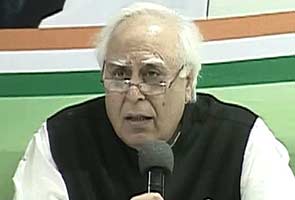
New Delhi:  The government has disconnected nearly 28,000 telephones till April 24 for sending pesky calls and SMSs using private numbers, Union Telecom Minister Kapil Sibal said, while adding that the government has also issued close to 45,000 notices to unregistered telemarketers.

"The government is aware that several calls and SMSs are being sent from private numbers. 44,810 notices have been issued to unregistered telemarketers and 27,984 telephones have been disconnected till April 24, since inception of the regulation," Mr Sibal informed the Parliament.

In order to put curbs on such communications, the Telecom Regulatory Authority of India (TRAI) had issued 'The Telecom Commercial Communications Customer Preference Regulations, 2010', which came into force from September 27, 2011.
The regulation says that if an Unsolicited Commercial Communication (UCC) originates from a subscriber who is not registered with the regulator as a telemarketer, the service provider shall issue a disconnection notice to that subscriber. On second offence, the service would be disconnected.

To facilitate easy identification, the telemarketers registered with TRAI are allocated numbers series '140'. Subscribers can register with the National Customer Preference Register (NCPR) to either bar all commercial communication under the 'Fully Blocked' category, or be in the 'Partially Blocked' category, where he/she will receive SMSs in categories chosen.

The regulation also prescribes a cap of 200 SMSs per day per SIM to deter sending of bulk unwanted SMSs by private numbers.

In case of violation of regulation by registered telemarketers, TRAI has recommended penalty ranging between Rs. 25,000 to 2.5 lakh for a violation.

Saturday, 5 May 2012

Chelsea beat Liverpool 2-1 to win FA Cup

Didier Drogba delivered Chelsea's fourth FA Cup triumph in six seasons on Saturday by becoming the first player to score in four finals to help the Blues survive a second-half Liverpool onslaught for a 2-1 victory.

After Ramires seized on Liverpool blunders to put Chelsea in front after 11 minutes, Drogba scored his eighth goal in eight games at Wembley in the 52nd minute of the 131st final of the competition.

Drogba slotted the ball through defender Martin Skrtel's legs and into the net after being fed by Frank Lampard as a lethargic Liverpool posed little threat.

"He is my hero," Lampard said of Drogba. "No striker I have ever played with has scored so many important goals in finals."

Liverpool substitute Andy Carroll breathed life back into the game when he pulled one back in the 64th after teasing his way around Chelsea captain John Terry.

He thought he had an equalizer as well when his close-range header was swatted away on the goal line via the crossbar by Petr Cech, but the referee waved away Liverpool's appeals for a goal and replays failed to show that the entire ball had crossed the line.

But, two weeks before the Champions League final against Bayern Munich, Chelsea held on to keep the recovery on track since Roberto Di Matteo replaced Andre Villas-Boas as coach two months ago when the team was in free fall.

"He has been brilliant," Lampard said. "He has turned the club around."

Terry became the first captain to lift the FA Cup four times with the same club, which has won the world's oldest knockout competition seven times.

"It's fantastic, it's what we live for," Terry said. "At times people have slated us as too old, past it or not together but as a team we come together and unite when our backs are against the wall and we've done that superbly in the last 16 or 17 games.

"We've still got a massive trophy, the Champions League that's the target for the owner from day dot. We've done Robbie a world of good and it can do him no harm."

For both Chelsea and Liverpool, the FA Cup has provided a distraction from miserable Premier League form, with both teams out of the top four Champions League qualification places.

"I'm very happy for players because we've been heavily criticized this season and we've got the trophy and have the chance for another one," Di Matteo said. "It's been a difficult season but the players have made the club proud. It's been hard work but we came through it."

In Kenny Dalglish's first full season in charge since returning after 20 years, Liverpool will have to settle with one trophy, the League Cup won here in February.

"They were better than us for the first hour," Dalglish said. "We finished really strong and if we'd started the way we'd finished we'd maybe have been happier than we are now. We've just got to learn the lessons."

It was a a cagey start to the final, but Chelsea was gifted an opener after a pair of mistakes by Liverpool.

Liverpool midfielder Jay Spearing initially gave the ball away in midfield to Juan Mata, who set Ramires free to charge toward the Liverpool goal.

And Pepe Reina was beaten too easily at his near post by Ramires when a shot was deflected by the goalkeeper's knee into his own net.

Liverpool pushed for an immediate response, but Branislav Ivanovic headed away Craig Bellamy's shot from the edge of the area.

But it was a shoddy first-half performance from a Liverpool side posing little threat and Chelsea went further in front at the start of the second half when Spearing gave the ball away again and Lampard threaded it through to Drogba, who slotted into the net.

Lampard hit a free kick wide and Drogba lashed the ball into the side netting before Liverpool's attempt at a comeback began.

Despite scoring the semifinal winner and being Liverpool's most expensive player, Carroll was dropped in favor of Luis Suarez up front, but the isolated striker struggled to make an impact.

Carroll, though, netted after just 10 minutes on the pitch.

Stewart Downing's tenacity down the left flank paid off, challenging Boswinga before the ball fell to Carroll to lash it into the net.

"Until they scored it was very, very comfortable," Lampard said. "They bombarded us and it was hard to deal with."

Liverpool pressed for the equalizer, with Gerrard volleying over and Suarez forcing a low save from Cech but Chelsea clung on.

The teams will meet again in the league on Tuesday, but any hopes Chelsea had of finishing in the top four could be over by then, while Liverpool is eighth.

IPL 5: Ganguly's Pune Warriors go down to Kolkata by 7 runs

Kolkata: It was certainly the most talked-about clash in the fifth edition of the Indian Premier League, with many highlighting May 5 as soon as the schedule was drawn up. The home hero Sourav Ganguly, up against the home team - Kolkata Knight Riders. The match did live up to the hype. And in the end, most people would have gone back happy with Kolkata winning and Ganguly playing a significant hand, albeit in vain.
 Kolkata batted first, and started brilliantly with Gautam Gambhir carrying on with his superb form. Brendon McCullum shared in a century-plus opening stand, but it was almost entirely the Gambhir show. He took charge early on, with 36 runs coming off the final two powerplay overs as Kolkata reached 68 for no loss. Even though the scoring slowed down a little thereafter, Kolkata were still looking good for 200 when they were 106 for no loss after 11 overs.

However, once Gambhir fell for a 36-ball 56 in the 13th over, things went totally pear-shaped. None of the batsmen could come to terms with the slowness of the wicket and Kolkata scored only 37 runs off the final 7.3 overs to end at 150 for 5.

A quick check shows that Kolkata scored 98 off the first 10 overs and only 52 off the last 10. But truth is that it was a difficult track to bat on, and if you take Gambhir out of the equation, it would have been very, very different. Which is what we saw in the Pune Warriors innings as well.

When Pune came out to bat, Marchant de Lange set them on the backfoot straightaway, dismissing Michael Clarke first and adding Robin Uthappa's wicket soon after.

Interestingly, Ganguly did not bat at his normal position, but came in to bat much lower down at number seven, acknowledging that his lack of form meant others deserved to go up the order. When he did come in, Pune were struggling at 55 for five in the ninth over, with Ganguly and Angelo Mathews the only specialist batsmen left.

Like in the first half of the match, Pune turned things around after the first ten overs, with Ganaguly and Mathews sharing a 73-run stand off just 56 balls before Ganguly fell. At the time, Pune still needed 23 off 14 balls.

What tipped the scales in Kolkata's favour was that six of those were bowled by man of the match Sunil Narine, who proved impossible to score off. He conceded just four runs in the 19th over, ending with figures of one for 13 from his four overs. Good enough for Kolkata to squeeze out a seven-run win at the end.

Eight coaches of Punjab Mail derail near Rohtak; 19 injured


Rohtak:  Eight coaches of Mumbai-Ferozpur Punjab Mail derailed early this morning, injuring 19 people. The incident occurred at around 3.30 am near Rohtak.

The injured have been taken to the PGI hospital in Rohtak.

According to the IG Railways (Haryana), 300 metres of railway track has been damaged but no casualties or major injuries have been reported.

The ill-fated bogies that derailed include sleeper coaches from S-5 to S-10, apart from the guard-cum-luggage van, officials said.

Railway authorities say that rescue operations have been launched and buses have been pressed into service so that the passengers do not suffer. They also said that the exact reason of the accident is still not known and that the coaches are being examined.

Anil Saxena, Public Relations Officer, Railways, said, "The Railways Minister himself spoke to the driver as well as the hospital authorities this morning. The Railways will bear the cost of treatment."

He also said that one person has been seriously injured, while others have sustained bruises. "The traffic between Delhi and Rohtak has been affected; our teams have reached the spot and are trying to clear the tracks," Mr Saxena added.

The train was scheduled to reach Delhi by 8 am.

Friday, 4 May 2012

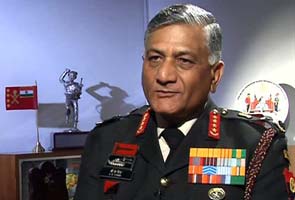
Will Army Chief be summoned in defamation case? Delhi Court may decide today


New Delhi:  A Delhi Court is expected to decide today whether to summon Army Chief General V K Singh in connection with a defamation suit filed against him by retired officer, Lieutenant General Tejinder Singh.  In the initial hearing on April 26, the court had deferred its decision.

Lt Gen Tejinder Singh claims that allegations made against him in a March 5 press release issued by the Army are "completely false and concocted". One of those allegations is that he offered General VK Singh Rs. 14 crore in bribe on behalf of a company called Vectra in 2010. The Army Chief had caused a stir when he made that allegation in an interview in March.

The matter is now being investigated by the Central Bureau of Investigation (CBI), which recorded Gen Singh's statement last month and on Wednesday questioned Lt Gen Tejinder Singh.
 Ravi Rishi, the CEO of Vectra, which provides Tatra trucks to the Army, has also been questioned by the CBI.  Mr Rishi has denied that Lt GenTejinder Singh either formally or informally represented Vectra as a middleman.

Lt Gen Tejinder Singh had testified before the court last month and sought that the court summon the Army Chief.

The retired Army officer had also approached the Supreme Court last month, asking it to sanction a CBI inquiry against the Army Chief for allegedly ordering the illegal monitoring of phones in the Defence Ministry. Lt Gen Tejinder Singh says the CBI should raid the homes and offices of Army Chief General VK Singh and his relatives.

News in Brief Our Dumb Readers Shove The Onion Down Your Friends' Throats Mosquitoes Don't Even Need To Bite Us, Study Shows

MINNEAPOLIS—According to a study published Friday by researchers at the University of Minnesota, mosquitoes have no physiological reason to bite humans, and in fact do so only out of spite. "For years, entomologists assumed members of the Culicidae family drew blood for sustenance, but as it turns out, they feed almost exclusively on pollen," said study author Dr. Robert Benenson, who explained the sociopathic insects either spit out human blood immediately after they bite, or else carry it from person to person, gratuitously killing millions as they spread diseases like malaria and dengue fever. "While there is literally zero biological necessity for their bloodsucking behavior, mosquitoes enjoy putting a damper on our outdoor activities and expend tremendous energy spreading deadly pestilence throughout the world. They just really, really hate us." Benenson noted that mosquitoes bite a variety of vertebrates besides humans and are especially fond of leaving itchy patches on the skin of baby pandas, koala bears, and very small puppies.

Thursday, 3 May 2012

No decision yet, there’s time: Sonia


Sonia Gandhi indicated today that the UPA was still in the process of evolving a consensus on the next president. The UPA chairperson met crucial Congress ally Mamata Banerjee, who met Samajwadi Party chief Mulayam Singh Yadav immediately afterward.
“There is no confusion. Be patient, still there is time,” Sonia said, seeking to put at rest speculation that followed remarks by Congress spokesperson Renuka Chowdhury suggesting that Pranab Mukherjee might be too important for the UPA to be made president.
Chowdhury was subsequently forced by senior party leaders to retract, and Congress spokesperson Rashid Alvi clarified that Mukherjee’s name could not be ruled out.
Mamata appeared to send out a few signals of her own today. She drove to his residence for a discussion soon after meeting Sonia and, after an hourlong meeting with the SP chief, announced, “Whatever we will decide, we will decide jointly.”
Earlier in the day, Mulayam had said that “the president should always be a political person” — a statement that was interpreted as the SP ruling out another term for former president APJ Abdul Kalam.
Mamata said today, “He (Kalam) has had his term.” Asked about potential candidates, she said, “All options are open.” She also steered clear of stating a preference between Mukherjee and Vice-President Hamid Ansari, the two frontrunners for the UPA.
“He (Pranab Mukherjee) is a member of the Congress party. How can I speak

for the Congress? I know my boundaries, I never cross them,” Mamata said. Earlier, amid the confusion created by Chowdhury’s remark, she had said, “I think their party has already announced today that he (Mukherjee) is not (the candidate)... I cannot say anything.”

Samsung Galaxy S III official: 4.8-inch HD display, 8MP camera, S-Voice

As promised, Samsung unveiled its next generation Galaxy smartphone at company's Mobile Unpacked event in London.
Dubbed as Samsung Galaxy S III, the smartphone improves on the predecessor in many ways. First, you've got the addition of quad core processor, in the form of company's own Exynos 4 Quad. It has four cores clocked at 1.4GHz.
It also runs on Android 4.0 'Ice Cream Sandwich', but as expected it will feature Samsung's custom Touchwiz user interface. Company revealed that the brand new version of Touchwiz offers added functionality, including S-Beam, Smart Stay and S Voice, plus a 'pop-up video' feature that allows you to view a video while doing other tasks.
Smart Stay uses the smartphone front camera to identify when your eyes are looking at the display and keeps the display bright for optimal viewing. On the other hand, S Voice is like a Siri competitor and responds to voice commands. Lastly, S-Beam is an upgraded version ICS's inbuilt Android Beam. It allows you to quickly transfer files between phones.
"With the Galaxy S III, Samsung has maximized the consumer benefits by integrating superior hardware with enhanced smartphone usability," said JK Shin, President and Head of IT & Mobile Communications Division at Samsung.
"Designed to be both effortlessly smart and intuitively simple, the Galaxy S III has been created with our human needs and capabilities in mind. What makes me most proud is that it enables one of the most seamless, natural and human-centric mobile experiences, opening up a new horizon that allows you to live a life extraordinary," he added.
Coming to other features of the smartphone, Samsung Galaxy S III will have a 4.8-inch Super AMOLED 720p display, 8-megapixel rear camera, and 1.9-megapixel front-facing camera. While both front and rear camera in the smartphone features a zero-lag shutter speed, the rear camera also comes with the 'Burst shot' function that instantly captures twenty continuous shots.
The Samsung Galaxy S III will be available from May 29 in Europe before rolling out to other markets globally. Company has also planned a big ten city marketing tour for the smartphone, which will kick-off on the same day.

Firth fashions a green path for Hollywood

London (CNN) -- The red carpet is fashion's grandest stage where stars line up to see and be seen. But who you are wearing is as important as who you are.
If Livia Firth, wife of Academy Award-winning actor Colin, gets her way, the kind of fabric you are wearing will be just as essential.
Now in its third year, the Green Carpet Challenge was established to persuade top designers to dress the world's most famous faces in clothing that is ecologically friendly and socially responsible.
"First of all, you want to wear something that is made with non-toxic materials and dyes and also that it's made by people who are happy fundamentally," Firth says.
She has worn yarn made from recycled plastic bottles to the Golden Globes, material from repurposed thrift store finds for the Oscars and discarded fabric to meet Queen Elizabeth II.

Now she is persuading some of the biggest names in film and fashion to follow suit including designer and film director Tom Ford, Hollywood legend Meryl Streep and rising star Michael Fassbender.
"A designer will create a gown for an actress anyway. So what we do is to work with the designers to switch the fabric to eco-alternatives," Firth said.
One of Firth's own "green carpet" triumphs was an emerald green gown made of upcycled fabric created from scratch by British designer Henrietta Ludgate who produces her designs out of a small workshop/showroom in London.
"We source from mills in Scotland and England. We upcycle fabrics and we produce everything locally. It's zero clothes miles," Ludgate said.
Sourcing fabrics this way allows Ludgate to oversee every step of the production process which she says leads to a superior product but not perhaps superior profits.
"People buy for design rather than sustainability. When they find out about it, I'm hoping that they will buy more!"
But fashion journalist Lucy Siegle would like to see people buying less.
She started the Green Carpet Challenge with Firth in 2009 in the hope it would encourage people to try new things with uncommon materials and clothes already in existence.
"Innovation, as it's told by mainstream fashion, is about wearing the latest look from the latest celebrity or whatever," Siegle said.
"Ironically, we are working with celebrities, but we're showing that it's not just about imitating a trend. It's actually about techniques, about tailoring and heritage fabrics. It's about the narrative of a piece," she added.
It's a trend that Livia Firth hopes will continue.
"Next year we hope to have a dedicated lane at the Oscars for the Green Carpet Challenge people," Firth said.

HTC One X hints at iPhone 5 challenges

The HTC One X is living proof that big processors and LTE don't pair up easily in phones. This may offer a lesson in what to expect in the upcoming iPhone.
Qualcomm has cornered the market -- at the moment -- for putting LTE functionality and the processor on one piece of silicon. Thus, we have the HTC One X (and reportedly the Verizon Galaxy s3) coming to Verizon with dual-core and LTE -- not quad-core as some had hoped.
And we may be seeing a pattern: the same phone (e.g., the HTC One X) being announced in Europe with quad-core, then announced in the U.S. with dual-core.
What does this mean for Apple? Well, the current A5X chip in the third-generation iPad probably wouldn't find a very happy home in the next iPhone if it's packing LTE. The quad-core A5X is relatively big and uses lagging-edge Samsung manufacturing technology (which is one of the reasons it's big).

Of course, things will improve if Apple is able to tap Samsung's more-advanced 32-nanometer manufacturing tech. But will that be enough to package LTE and, let's say, a more demanding A6 or A5X chip into the next iPhone? Remember, fitting quad-core (in the case of the A5X, quad-core graphics) into an iPad is not the same as shoehorning it into a smaller iPhone.

The problem is that Apple uses the same chip ecosystem as everyone else. And it's not immune to the same manufacturing challenges that more seasoned chip companies like Nvidia, Texas Instruments, and Qualcomm face.
"You have to compromise on the processor in the U.S. to get LTE right now. And I do think the Qualcomm S4 is a compromised processor versus a quad-core Tegra," said Patrick Moorhead, president and principal analyst at Moor Insights & Strategy.
"If you use a large-screen phone as a small tablet there can be a [performance] penalty," he said, referring to the dual-core Qualcomm S4.
That said, the Qualcomm Snapdragon S4 MSM8960 "Krait" system-on-a-chip in the One X isn't exactly slow. "[It] is easily the fastest or among the fastest on the market today. Android feels very smooth and snappy on the AT&T One X. Applications load quickly, as do web pages," said Anandtech.
And rest assured that the solution Apple comes up with for the next iPhone likely won't be wanting in performance. But it will be interesting to see how Apple gets there.